by Emily Lathers
In 1921 Weimar Germany, Walter Benjamin published his essay, “Critique of Violence,” which conceptualizes the interlocking binaries of natural law and positive law, law-making violence, and law-destroying violence, and mythic and divine violence. Benjamin’s “Critique of Violence” is a call to the leftist socio-political movements of the time to stop trying to enact change through the political institutions that are fundamentally built against them. He argues against the use of mythic violence to maintain the intrinsically flawed systems of oppression that govern entire peoples, but rather for the use of divine violence to destroy them.
Nearly three centuries earlier, in 1651, during the middle of the English Civil War and the Wars of the Three Kingdoms, the vast reshaping of political and philosophical thinking from the Enlightenment, the rise of the British empire-state, and the growing prominence of global colonization, Thomas Hobbes published Leviathan or The Matter, Forme and Power of a Commonwealth Ecclesiasticall and Civil. Hobbes’s tome is a forty-seven chapter-long examination of sovereign power, the commonwealth as a solution to the “state of nature”, and the role of religion in a “Christian Commonwealth”—offered as a guide on wielding power for the sovereign (Hobbes 489).
Hobbesian logic has virally infected the fields of international relations, moral philosophy, and modern politics, such that many thinkers struggle to frame their theories without Hobbes’s influence. The ways in which this logic has been twisted, interpreted, and rethought by countless other theorists has undoubtedly contributed to current international relations, moral philosophy, and global economic policy. We therefore see the need for a method of conceptualizing modern politics that does not rest solely on Hobbesian logic—which many problematic justifications for colonialism and empire also rely on—but instead combines the work of multiple revolutionary thinkers to theorize the problem of inequality, systemized discrimination, and “Othering” present in the 21st century American political institution.
The writings of Walter Benjamin, Thomas Hobbes, and Donna Haraway are parallel histories that may be used together to explain the highly complex systems of power that govern 21st century political society. Walter Benjamin’s “Critique of Violence” may provide another lens besides Hobbes through which to view international relations, moral philosophy, and modern politics. Donna Haraway’s construction of the cyborg in “A Cyborg Manifesto” (1983), traditionally referred to as a human-machine hybrid or “cybernetic organism,” may “suggest a way out of the maze of dualisms in which we have explained our bodies and our tools to ourselves” (103, 116). These dualisms—life versus death, self versus other, mind versus body, civilized versus primitive, and agent versus resource for instance (Haraway 113)—are seen prominently in the western political philosophy tradition and are a frame of logic that many thinkers seek to escape in order to gain a truer, more original construction of sovereignty and society. I seek to use these schools of thought—in addition to Lakitsch’s “Hobbes in the Anthropocene: Reconsidering the State of Nature in Its Relevance for Governing” (2021)—to construct a theory for the impact of actual divine violence on the destruction of systems of oppression in the 21st century empire-state called America.
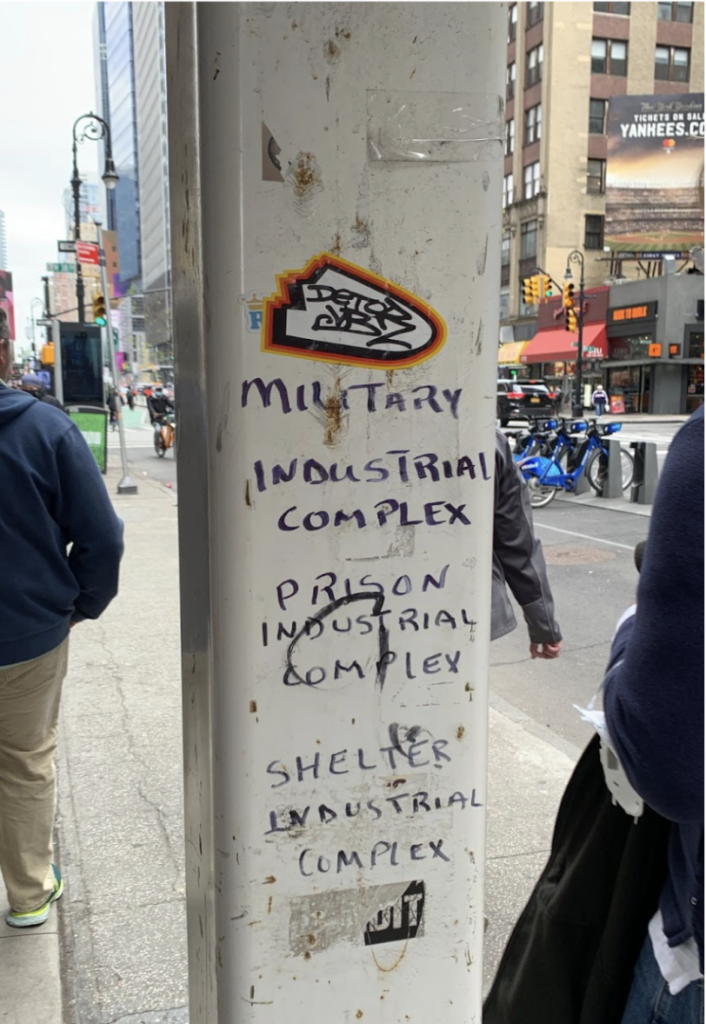
When walking in New York City this past April, I was stopped in my tracks by graffiti written on a nearby street post (see image). It states simply: “military industrial complex, prison industrial complex, shelter industrial complex.” I had never before seen the fundamental, systemic flaws of American society laid out in such plain terms and in plain sight for the thousands of people who traverse that street every day to set their eyes upon and hopefully have the memory of those words remain in their mind. For if individual minds are reminded of the continued existence of these industrial complexes that perpetuate the “Othering” of difference itself and that support the institutionalized discrimination of people on the basis of race, class, gender, and other identity categories, then one step has been taken towards dismantling the systems of power that such complexes rely on for their existence.
Walter Benjamin’s Divine Violence
I find this graffiti to be a prime example of Walter Benjamin’s notion of “divine violence,” a construct that may be incredibly useful here for rethinking and changing the systems of inequality founded by settler colonialism—systems which must undergo radical change if true equality is to be realized past the abstract, raceless, and genderless philosophical “equality.” Divine violence for Benjamin is “law-destroying violence,” violence with no clear end. Benjamin juxtaposes divine violence with mythic violence, which is “lawmaking” and therefore “powermaking” (Benjamin 249). He writes, “Mythic violence is bloody power over mere life for its own sake; divine violence is pure power over all life for the sake of the living” (Benjamin 250). If mythic violence creates power, divine violence deconstructs and demolishes systems of power.
Divine violence may be one of the only tools granted to marginalized people to enact tangible, systemic change. I posit that any grassroots form of political organizing for people whom the United States political system is built against is a form of divine violence. Whether this action manifests itself through in-person protest, writing and publishing essays, graffiti that conveys a political message (see image), or imagination itself, it ultimately seeks to dismantle systems of power and remind those in privilege of the continued existence of those they seek to destroy. Walter Benjamin writing “Critique of Violence” as a gay Jewish man in Weimar Germany may have been an act of divine violence itself. These acts are calls from those labeled as an “Other” that the settler colonial project to erase their voices has not yet succeeded and should not succeed.
Divine violence may thus be seen in people taking action directly against the political system while facing systemic oppression from that same system. Benjamin is careful to make the distinction that social protest using the natural law tradition and the existing political system is not true liberation. Mythic violence—violence for the sake of violence that supports existing power structures—will not progress the social movements in support of marginalized communities. Such violence is the very foundation of the same biopolitical state rooted in settler colonialism that attempts to destroy and erase marginalized communities for their supposed “Other”-ness. Divine violence, rather, must involve people taking action for themselves. Moreover, the biopolitical sovereign’s portrayal of some as an “Other” is designed to limit any cross-community support. For if the subjects of a sovereign, even those who themselves are marginalized, are forever taught to believe in the “Other,” sovereign power will not be threatened. Rather, it is through socio-political division and taught hostility towards difference that sovereign power is maintained.
To interpret the graffiti above under the framework established by Benjamin in “Critique of Violence” is to emphasize the existence of the graffiti itself—physical writing on part of the city street—as contradictory to and destructive of the law itself. Graffiti is not a legal way of sharing one’s message; its status “outside the law” may instead mean that it is more effective at sharing this message (Benjamin 252). The fact that those words remain on that street post means that divine violence, this “revolutionary violence” that seeks to destroy the system that is built against so many and has brutally hurt more, is possible (Benjamin 252). The concepts of military, prison, and shelter industrial complexes themselves imply that radical institutional change is needed to reach true justice. As quoted earlier, “divine violence is pure power over all life for the sake of the living,” (Benjamin 250). This act of divine violence argues for the preservation of the lives of those whom the military, prison, and shelter industrial complexes disproportionately harm. It has power over all who simply walk by it and read its words. If this graffiti remains in the minds of any who pass by, if they find themselves recalling these words hours later, then this act of divine violence will have succeeded. It will have therefore altered an individual’s way of thinking of the origins of the United States as an empire-state and remaining systemic racism in America. Because the continuous “Otherings” are as much present in the minds of a constituency as they are intrinsic in the system itself, this graffiti to cause a change in thinking may be considered an act of revolutionary divine violence.
Donna Haraway and the Cyborg Theory
Donna Haraway’s 1983 essay “A Cyborg Manifesto” may also provide a useful framework through which to analyze divine violence and the need for radical institutional change in America. Haraway provides an alternative to “that great Leviathan,” the “Mortall God” to which all people ruled by a sovereign give up their “Will” and “Right of Governing” themselves, as the “cyborg” itself (Hobbes 120). For Haraway, we are the cyborgs, but the cyborg is also the machine that generates our politics, our wars, and our economic systems (104). Haraway’s cyborg is at the forefront of an organism versus machine “border war;” Haraway argues for responsibility and accountability in the construction of these borders (104). The cyborg skips the state of nature, “the step of original unity” as identified by Hobbes, Locke, and Enlightenment thinking, and instead commits itself directly to “partiality, irony, intimacy, and perversity” (Haraway 105).
Haraway uses the cyborg to explore “boundary ruptures” between humans and “nonhuman animals,” organisms and machines, and the material and immaterial (Haraway 103). The cyborg creates a materialized response to the existing system of control – a threat to the status quo that maintains power and privilege – while simultaneously exists, Haraway states, as the offspring of militarism, patriarchal capitalism, and state socialism (105). Haraway responds to this notion with, “illegitimate offspring are often exceedingly unfaithful to their origins” (105). “A Cyborg Manifesto” clarifies the boundary breakdowns between human and nonhuman, organism and machine, and physical versus non-physical or immaterial, contributing to the argument for a breakdown of identity categories. Against the “natural matrix of unity,” Haraway cites the “fraying of identities” as containing possibility for effective revolution rather than indefinite complicity in the political system and the ultimate failure to make change (Haraway 109).
Haraway uses the cyborg to explore “boundary ruptures” between humans and “nonhuman animals,” organisms and machines, and the material and immaterial (Haraway 103). The cyborg creates a materialized response to the existing system of control—a threat to the status quo that maintains power and privilege—while simultaneously exists, Haraway states, as the offspring of militarism, patriarchal capitalism, and state socialism (105). Haraway responds to this notion with, “illegitimate offspring are often exceedingly unfaithful to their origins” (105). “A Cyborg Manifesto” clarifies the boundary breakdowns between human and nonhuman, organism and machine, and physical versus non-physical or immaterial, contributing to the argument for a breakdown of identity categories. Against the “natural matrix of unity,” Haraway cites the “fraying of identities” as containing possibility for effective revolution rather than indefinite complicity in the political system and the ultimate failure to make change (Haraway 109).
Lakitsch and the Anthropocene
Furthermore, an additional alternative to Hobbesian thought may rest in Maximilian Lakitsch’s essay “Hobbes in the Anthropocene: Reconsidering the State of Nature in Its Relevance for Governing” (2021). The Anthropocene, for Lakitsch, is an alternative to Hobbes’s theory of the commonwealth as a catalyst for peace, and continues to draw upon actor-network theory and Hobbes’s theory of a state of nature. This essay argues for a rethinking of “human reasoning as sovereign and independent from the world” and for an embrace of a posthumanist construction of the “self” in relation to sovereignty and nature (Lakitsch 4). Lakitsch writes, “affirming the Anthropocene returns mankind to a cosmos of infinite human-nature interrelationships,” resembling Hobbes’s “premodern” state of nature” (Lakitsch 3).
For both Lakitsch and Haraway, the notion of the individual is not at all singular. Within Lakitsch’s construction of the Anthropocene, “no human being is a self-contained unit, but is able to articulate itself as a self” (Lakitsch 10). Additionally, his construction of the Hobbesian “multitude” calls for collective power, belonging to everyone and is the only power able to control itself (Lakitsch 10). Similarly, Haraway discusses the self with “To be One is to be autonomous, to be powerful, to be God; but to be One is to be an illusion” (Haraway 113). Lakitsch’s and Haraway’s constructions of the self are therefore not independent from their surroundings, but rather depend on their contexts, interactions with others, and role in the “multitude” for their power.
As Lakitsch’s political realm includes a “nature” that is just as vulnerable to violent death as humans, he concludes that “directly governing the infinitely interrelated world of the Anthropocene is not possible” (Lakitsch 11-12). Still, for Lakitsch, “as in the state of nature, violence remains a defining property of a world that is complex beyond human comprehension” (Lakitsch 12). This state of nature that Lakitsch falls back upon and its inevitability of violence lends itself to the logic established in Walter Benjamin’s “A Critique of Violence” and the conclusion that divine violence is needed to establish tangible, radical change.
Haraway’s cyborgian framework and Lakitsch’s theory of the Anthropocene can also be used to discuss the significance of this street graffiti as an act of divine violence. A cyborgian analysis of this graffiti may highlight its existence on a piece of metal, in a city of metal, asphalt, gas, and smoke—all evidence of human society and “development.” This graffiti by no means exists alone in a state of nature, but it is a direct product of its context, like Lakitsch’s and Haraway’s constructions of the self as situation-dependent. The graffiti appears authorless; we do not know who has written these words, when they appeared, or how they were written. This apparent mysticism surrounding the graffiti may contribute to cyborgian “boundary ruptures” between “organism and machine” and between “the physical world and immaterial things” (Haraway 103-104). If one focuses on the seemingly authorless nature of the graffiti, it almost appears as if the street post has offered up these words to attempt to enact even the most miniscule of changes in the logic of passersby regarding these issues. These words take on new meaning among the street posts, cars, and city streets rather than the trees that perhaps once stood there. Using Lakitsch’s notion of “infinite human-nature interrelationships,” this graffiti itself and the rethinking it inspires are yet another human-nature relationship (Lakitsch 3). Thus, another cyborgian “boundary rupture” has occurred, as words take on human-like attributes. Words written on a street post—literally just words—may cause a reconsideration of the political institution and processes of discrimination one is complicit in.
Furthermore, Lakitsch’s interpretation of the climactic Leviathan and its implications for nature in the 21st century may be used here to consider the graffiti a call to the Hobbesian “multitude.” Discussion of the Hobbesian “multitude” in Lakitsch’s essay reveals that “power is not an ability that belongs to someone or something, but to everyone” (Lakitsch 10). Anyone has the power to write words on a street post that may change the way thousands of people think about their surroundings, their privileges, and their institutional complicity; the question is only whether or not one is inspired to conduct divine violence. As Lakitsch writes, “only the power of the multitude can control the multitude” (10). Because this graffiti came from the multitude—it was produced “outside the law” by a city-goer, just like you or I—it has the power to enact ideological change that an act of law-preserving mythic violence never can (Benjamin 252). The theories of the Hobbesian “multitude,” Lakitsch’s infinite human-nature relationships, Haraway’s organism versus machine and material versus immaterial dichotomies, and Benjamin’s divine violence in the context of this graffiti therefore all serve to reveal the role of radical action in the need for institutional change.
In “A Cyborg Manifesto,” Haraway discusses the role of radical feminists like Susan Griffin, Audre Lorde, and Adrienne Rich for theories of ecofeminism in relation to the cyborg (111). I find Audre Lorde’s 1984 essay, “The Master’s Tools Will Never Dismantle the Master’s House,” in Sister Outsider to speak directly to the need for radical change in American political and social institutions. To use Benjamin’s terms, mythic violence will not bring the change that is so separately needed. It is divine violence that will bring this change. Lorde writes, “the master’s tools… may allow us temporarily to beat him at his own game, but they will never enable us to bring about genuine change” (27). Lorde mirrors Benjamin’s argument: a plea to the social movements of the time to stop using the tools providing by the existing racist, sexist, homophobic, and classist political system to attempt to enact lasting change, because it will not work. Instead, revolutionary divine violence is needed to destroy existing power structures and act “for the sake of the living” (Benjamin 250). This is only possible if the ideological construct of the “Other,” created to preserve power of those in privilege, is also destroyed. Lorde continues, “Only within that interdependency of different strengths, acknowledged and equal, can the power to seek new ways of being in the world generate, as well as the courage and sustenance to act where there are no charters” (26). Just as whomever wrote the words of that graffiti on the street post, the courage and inspiration to act “outside the law,” “where there are no charters” is necessary for divine violence to be successful and for radical institutional change to be possible (Benjamin 252, Lorde 26).
Sources
Benjamin, Walter. “Critique of Violence.” Walter Benjamin: Selected Writings, edited by Marcus Bullock and Michael W. Jennings, vol. 1, Harvard University Press, Cambridge, MA, 1996, pp. 236–252.
Haraway, Donna. “A Cyborg Manifesto.” Simians, Cyborgs, and Women: The Reinvention of Nature, 1991, pp. 103–118.
Hobbes, Thomas. Leviathan. Edited by Richard Tuck, Cambridge University Press, 2019.
Lakitsch, Maximilian. “Hobbes in the Anthropocene: Reconsidering the State of Nature in Its Relevance for Governing.” Alternatives, vol. 46, no. 1, Feb. 2021, pp. 3–16, doi:10.1177/03043754211008677.
Lorde, Audre. “The Master’s Tools Will Never Dismantle the Master’s House.” Sister Outsider, 1984, pp. 25–28.