by Kestrel Valdez
In Leviathan, Hobbes sets out to make a theory of politics that would be a ‘science’. In this tradition, Hobbes aimed to classify the 1) source of sovereign power (who/what/how), 2) the duties and roles of state power (why) and the 3) contingencies and limits of state power (when). In this pursuit, he traces state power to the individual people, who in tandem all individually transfer their natural right to govern themselves to their sovereign. People give up their naturally endowed rights to self-govern for the protection, safety, industry and general quality of life found within this constructed civil society. This transfer is done through a metaphorical contract and so it follows that the sovereigns’ power is constrained by the terms of this unspoken, unwritten but commonly acknowledged contract. In many ways though, this political science can better be understood as a political myth. His myth of a leviathan, drawn from the biblical sea monster, was in fact represented not as a monster, but as an artificial man, a large man, a king on the frontispiece of the Leviathan. This humanoid metaphor translated the large and abstract into the understandable in similar ways that Donna Haraway does in her presentation of the cyborg in A Cyborg Manifesto.
Donna Haraway interrogates, feminism a similarly abstract entity such as political sovereignty and presents a conception of possibilities for organizing and action. Similarly to Hobbes’ Leviathan, Haraway’s A Cyborg Manifesto is an outlining of power, a tracing of the sources, ends and parameters that cyborgs are defined by. The strength of Haraway’s cyborg theory lies in its comprehensiveness and its true commitment to materialism. In this way, the cyborg embraces many of the contradictions and absurdities we have become so accustomed to in our daily lives and in the age of covid-19 especially. Though, as I will return to later in this post, I am skeptical of the cyborg theory’s ability to provide a path forward, as it becomes ultra-comprehensive. In many ways, Haraway’s cyborg is not a rejection of Hobbes’ Leviathan, but an expansion with modifications, an update, a newer model you might say. And in this renewed theory, she addresses many endemic issues scholars across fields have found with Hobbes’ political theory. I will outline the key aspects of the Cyborg in conversation with the ways it addresses and provides a vision for resolving these concerns.
1) The cyborg is embodied experience
Communications technologies depend on electronics, Modern states, multinational corporations, military power, welfare state apparatuses, satellite systems, political processes, fabrication of our imagination, labor control systems, medical constructions of our bodies, commercial pornography, the international division of labor, and religious evangelism depend intimately upon electronics. Microelectronics is the technical basis of simulacra; that is, of copies without originals. Microelectronics mediates the translations of labor into robotics and word processing, sex into genetic engineering and reproductive technologies, and mind into artificial intelligence and decision procedures.
Haraway, pg. 165
In The Erotic Political Philosophy of Thomas Hobbes, Joanne Boucher makes the case that Hobbes political philosophy because of his materialist tradition is rooted in embodied experiences. Hobbes did not lack accounts of the erotic from his discussions on human nature or politics like is traditionally assumed, nor did he accept it as, “vitally important for human life” instead, it is supremely entwined with everything as embodied experiences are the ultimate truth of reality for Hobbes’ materialist framework. The material, embodied experience is ultimate to understanding Hobbes conceptions of power. From his initial accounts of physics and motion to the individual man and his own passions and interests (hunger, exhaustion, arousal etc.), the realities of the bodily experience shape and inform Hobbes’ political theory. So it is in this way that Haraway’s cyborgian leviathan might address the problems Boucher outlines in traditional analyses of Hobbes’ work which do not understand this relationship. Haraway’s cyborg theory is very much the result of a concerted effort to center the embodied experiences in understandings of the mechanisms of power. And as technology has become so pervasive, she is right to give it such political importance; machines require a place in this discussion as they have come to construct and influence our bodies in intimate ways. Machines are embodied experience; machines are the mechanisms that we experience our lives by and the mechanisms that power is exerted through. Their intimate relationship with our bodies places them as important considerations in the political sphere. The ramifications of this changes our views on what it means to be a human. It is no longer just ‘human,’ what we are is increasingly imagined in connection with machines.
2) The Cyborg transcends dualisms
Nature and culture are reworked; the one can no longer be the resource for appropriation or incorporation by the other. The relationships for forming wholes from parts, including those of polarity and hierarchical domination, are at issue in the cyborg world.
Haraway, pg. 151
One of my premises is that most American socialists and feminists see deepened dualisms of mind and body, animal and machine, idealism and materialism in the social practices, symbolic formulations, and physical artefacts associated with ‘high technology’ and scientific culture.
Haraway, pg. 154
In Hobbes in the Anthropocene: Reconsidering the State of Nature in Its Relevance for Governing, Maximilian Lakitsch questions the distinctions between nature and man especially in the age of the Anthropocene but throughout human history as well, “after all, it reveals that nature has always been a crucial actor in human history rather than its background. While we move earth, earth is also moving us” (Lakitsch, pg. 4) Lakitsch claims that in Hobbes’ attempt to make a theory of government, he had to exclude an assortment of factors that were unpredictable and uncontrollable, including nature and other non-human things. These entities were ceded of any power or influence they might have on society because of their unruly nature. But this creation of an ‘artificial’ leviathan is in vain because it removes and separates that which cannot be removed and separated. It is in this way that it might sound ironic to those unfamiliar with her work but, Haraway’s cyborgian leviathan might encompass nature more genuinely than Hobbes traditional one. Haraway’s cyborg embraces the converging influences of nature, machine on man and vice versa and does not seek to control or subjugate any entity. For Haraway, distinctions between man and nature are not only false, but they fail to serve a purpose anymore. They are so obviously deniable that the framework they provide is no longer a useful one for observing and understanding the world in which we have created and occupied. This lack of boundaries, lack of distinctions is key to the cyborg’s manifestation in society and in politics as well. A cyborgian theory of power draws its power from the multiple and contradictory forces a material society encapsulates.
3) The cyborg has no origin story
The relationships for forming wholes from parts, including those of polarity and hierarchical domination, are at issue in the cyborg world. Unlike the hopes of Frankenstein’s monster, the cyborg does not expect its father to save it through a restoration of the garden; that is, through the fabrication of a heterosexual mate, through its completion in a finished whole, a city and cosmos. The cyborg does not dream of community on the model of the organic family, this time without the oedipal project. The cyborg would not recognize the Garden of Eden; it is not made of mud and cannot dream of returning to dust.
Haraway, pg. 151
In The Domestic Analogy Revisited: Hobbes on International Order David Singh Grewal questions the traditional International Relations theory that extrapolates Hobbes analogy between people coming into society under a sovereign, out of a state of nature, to, states coming under an international sovereign (committee or organization of the sort), out of a similar, lawless state of nature. To Grewal, this is a misinterpretation of Hobbes’ beliefs; he never advocated for an international sovereign and saw the solution to international conflict being “not analogous but rather identical to the solution to domestic strife: both would be overcome through the establishment of a “well-ordered commonwealth”. (Grewal, pg. 618) Additionally, this misreading, makes obfuscations and mischaracterizations of the nature of states. It is a false presumption, Grewal claims, that states act in similar manners as people, with the same passions, interests, and motivations. But Grewal’s most illustrious point lies in his observation that, this idea of individuals in a state of nature, was drawn from Hobbes understanding of states, in a lawless state of nature as he writes, “Thus reflection on domestic anarchy did not inspire accounts of international anarchy, but rather international anarchy theory of domestic.” (Grewal, pg. 641) So here, Grewal is not only calling into question how we justify a global leviathan but also presenting a world shattering realization here: that we have been knowing and understanding ourselves as individuals through the state; we have taken characteristics and dispositions that originated in states and assumed that their origins are in us. This issue of origin and in essence lineage is critical to understanding the (international) Leviathan. In reality, are we creating the Leviathan or is the Leviathan creating us? This question of murky origins is central to Haraway’s Cyborg theory in which she claims that cyborgs are not ‘legitimate children’, they do not have allegiance to our values, our traditions and beliefs. Cyborgs are free from the constraints of traditional political philosophy rooted in religious belief; they are not wedded to the ontological beliefs of creation and reproduction. So in an albeit potentially unsatisfying way, Haraway’s cyborg frees us from the question of origin and attribution by rendering it inconsequential.
Hobbes’ political myth of Leviathan continues to be enticing as a metaphor and framework as it translates the personal, embodied individual to the greater collective. It reduces the large and big abstract system to an individual as its root but also its model for operation. It is in this same style that Haraway comes to the myth of the cyborg, a reflection on the personal relationships that technology has wedded with us. This practice can be explained best by Hobbes when he says that the root of all knowledge is experience. The most intimate, full, and giving experiences are those we have as embodied ones in ourselves and with others. It can be understood why we attempt to know the unknowable through ourselves. This is complicated by a world where we might know ourselves less and less as we are reintegrated with nature and machines. But Lakitsch and Haraway see this loss of clear images/distinctions as not something necessarily bad but potentially liberating; Haraway even invites us to find, “pleasure in the confusion of boundaries and for responsibility in their construction” (Haraway, pg. 150)
But as our understanding of ourselves as humans becomes muddled by machines, and other forces of nature, so does our understanding of our society, government and way of life. In the absence of religion and the welcoming of machines, we have lost our origin story as Haraway illustrates. Origin stories serve a purpose of setting the parameters, showing the from where, why and how we operate. They give us guidelines for appropriate and not appropriate. So as Hobbes tried to outline his natural rights theory, in a way that could stand alone from religion, it now is up for discussion if a natural rights theory that takes humans to be just that, just human, is sufficient to outline morality, wrong and right and the basis of power. Machines do not only lack origin but in their merger with us, they remove us from our origins. This has the effect of making us feel, adrift, lost, unknown to ourselves. Throughout popular media this feeling of wandering, ungroundedness, and unknowing is seen and was further amplified in the onset of the pandemic in 2020.
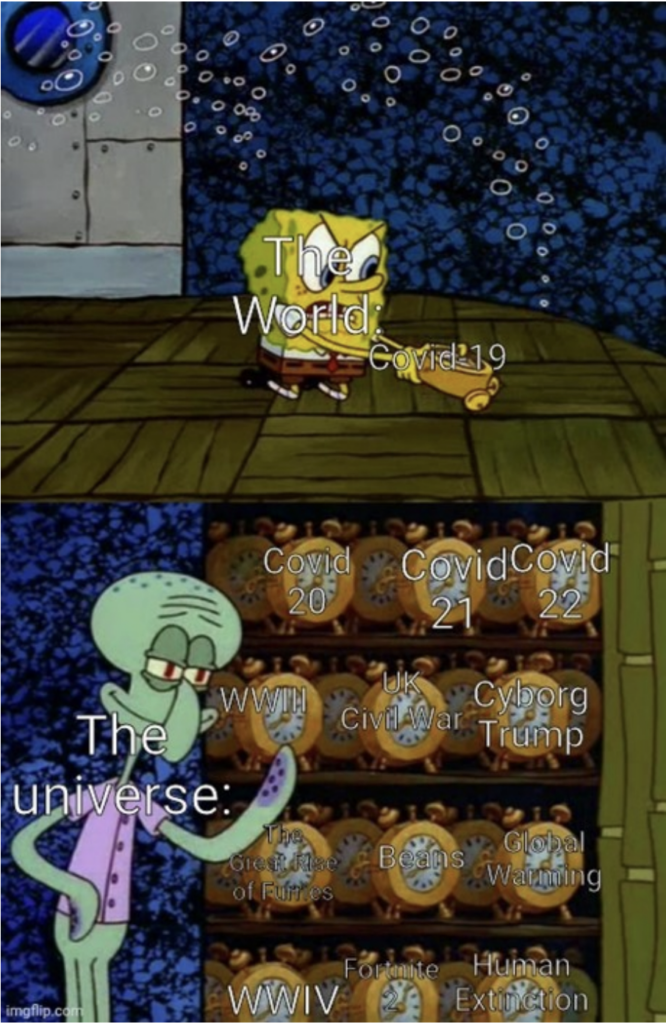
The image above, figure 1, is a prime example of this feeling of chaos, of unknowing, of
absurdity. The world today feels so unpredictable, it feels like things happen with no rhyme or
reason, thus the endless supply of absurd options in the universe clock closet: the endless
pandemics, natural disasters, war and the end of humanity with human extinction. Hobbes
and the enlightenment thinkers that followed him aimed to categorize and delineate human
experience and life itself into categories and subsequently many strict and counterposing
The image above, figure 1, is a prime example of this feeling of chaos, of unknowing, of absurdity. The world today feels so unpredictable, it feels like things happen with no rhyme or reason, thus the endless supply of absurd options in the universe clock closet: the endless pandemics, natural disasters, war and the end of humanity with human extinction. Hobbes and the enlightenment thinkers that followed him aimed to categorize and delineate human experience and life itself into categories and subsequently many strict and counterposing dualisms. For Hobbes this came from a desire to predict, to produce a science of politics that would be just that, a science, reliable and replicable, but, as Lakitsch and Haraway and other scholars have pointed out, these distinctions are not real in the material sense. We might like to live in a world that is predictable and categorical and understandable but that is just not the reality of our experience as humans, especially in the present day. As we start to interrogate the previously held beliefs we had that no longer stand up and the close and intimate relationships we have with machines, with technology, with viruses etc. we stop seeing the distinctions that previously upheld society. The distinction between machines and humans is blurred, thus cyborg Trump; Another of Haraway’s main claims, the distinction between animals and humans is blurred, thus The Great Rise of Furries.
The tone of this meme is not happy, it feels dreary and tired. SpongeBob is going mad trying to stop the ringing of the clock and unaware that there is an infinite supply of more madness the universe has in store for him. Haraway wrote A Cyborg Manifesto in 1985, a time when she was potentially standing on the precipitous merger between technology and humans becoming undeniable. It seemed hopeful and full of positive potential to Haraway’s feminist vision, with its blurring of distinction and counterposing identities. But now, the path that the cyborg has taken does not seem to be one that has brought with it security and peace and wellbeing to the individual, the original goals of Hobbes’ Leviathan. The image the cyborg represents in our common imagination is one that is closely related to power, in strikingly negative ways, seen in the ‘cyborg trump’ clock. We recognize the lack of control we have in our personal lives and over the machine; the cyborg and we fear it.
For these reasons, I question the cyborg’s vision. It seems like the cyborg is an accurate framework in how people are understanding their lives in the present moment. But it does not seem hopeful, it seems adrift, superficial, and murky. The cyborg does not present a vision for order and power in the traditional Hobbesian sense. Haraway sees that and presents the cyborg with an invitation to us to, “pleasure in the confusion of boundaries and for responsibility in their construction.” (Haraway, pg. 150) So I value Haraway’s cyborg for its descriptive power but, as its ideas are embraced and replicated in the popular culture, I am not hopeful about its salvatory nature. Instead, I view it as a warning, her call to acknowledge our ‘responsibility’. We are asked, is this a relationship we want to have with machines, is this relationship going to fulfill us and feel good in our bodies and spirits? Do we feel safe and content in a world devoid of mystical origin; do we feel secure in a world in the breakdown of established beliefs. It’s a difficult set of questions to answer it seems because, the world of Hobbes’ Leviathan doesn’t seem like a viable destination of return, disregarding the technological implications. These binary beliefs, origin and ontological beliefs that have a home in Hobbes’ thought have led to harm for an exhaustible list of groups of people. So maybe, the cyborg is a placeholder on the way to something new; or, there is some adjustment period needed for people to find their footing. To one where we can imagine ourselves as safe, happy and secure outside of the scope of what we have traditionally known.