by Aryan Ashraf
This semester, in the course HIST020 taught by Professor Farid Azfar at Swarthmore College, we explored Thomas Hobbes landmark 1651 book Leviathan and how the ideas presented within that book (with their iconic pessimism, authoritarian demands, and scientific, impersonal nature) seemed to continue to resonate long past 1651, even when the people involved in the discussion are denying any connection to Leviathan at all. In trying to characterize this long-lasting resonance of the ideas of Leviathan, we first read the book in its entirety and discussed our own interpretations and reactions to the work, and then we read papers in a number of different fields and studies and analyzed them for their ties to Leviathan, ranging from news articles on the COVID-19 pandemic to international relations to the war on terror. Near the end of this latter period, we read Donna Haraway’s impactful posthumanist, feminist work, “A Cyborg Manifesto: Science, Technology, and Socialist-Feminism in the Late Twentieth Century,” in which Haraway, like how Hobbes shapes the image of the mythical Leviathan in his book, similarly crafts the mythical image of the Cyborg. The question was then sprung: what would occur if we replaced the Leviathan with the Cyborg.
We chose to think about how this replacement would affect three particular areas of study: eroticism in political philosophy (as outlined by Professor Joanne Boucher), climate change
(as outlined by lecturer Maximilian Lakitsch), and international relations theory (as outlined by Professor David Singh Grewel). In order to do so, however, it would first be useful to
clearly describe the images of Hobbes’s Leviathan and of Haraway’s Cyborg and what these images imply about how politics and society function.
Hobbes saw humanity before/outside of the political state as living in a brutish, violent state of nature, in which inherent equality between people leads to envy that fuels a perpetual cycle of war between individuals. In turn, Hobbes’s solution to this problem, the escape out of this deadly state of being, is embodied through the Leviathan, an artificial man (that is extremely powerful but mortal) formed by a group of individuals in the state of nature seeking to escape it when they agree to give up their individual rights to govern themselves to a single sovereign, a sovereign that Hobbes goes as far as to argue should be a single monarch. The establishment of a commonwealth, the formation of a Leviathan, is the only way to escape the Hobbesian state of nature, and this Leviathan is described by Hobbes to be an artificial man in every sense of the term (the sovereignty is the soul, the magistrates are joints, the counselors are memory, etc.). The image of the Leviathan is supposed to signify the power granted to the leader(s) of a political state and is supposed to be a dual image of fear, indicative of both the fear of death from nature needed to create it and of the coercive fear needed to sustain it. This is furthered by the visual of the Leviathan from the frontispiece of the book: a larger than life man made up of several smaller individuals looking inwards (indicative of everyone’s consent in the formation of the being) looming over the commonwealth it leads. The image of the Leviathan on the frontispiece also depicts it holding a sword and a crozier, the sword once again representative of the fear and power involved with the Leviathan and the crozier a more complicated symbol for the Leviathan’s relationship with religion, one that diminishes the role of the Christian God in politics in favor of that of the mortal god that is the Leviathan. The Leviathan holding the crozier is also indicative of the Hobbesian sovereign’s power over opposition (or, at least, the suppression of it, since Hobbes considered civil war to be the death of a commonwealth), especially since religion during Hobbes’s time was a factor for the English Civil War he had to live through and write Leviathan within.
Haraway’s Cyborg, on the other hand, is less a symbol of the transformation from nature to society but rather a transformation of one society to another. The Cyborg is an embodiment of transgressing boundaries for Haraway, machine and organism hybrids seen in modern medicine, production, war, and more, creatures of social reality and fiction, beings born out of breaking the distinction between humans and animals, working to break down the distinction between organism and machine, and actively muddying the difference between the physical and nonphysical. The Cyborg is post-gender, existing in a world where there is no difference between the public and private sphere, in a world where the white heterosexual cisgender male is not the standard to be resembled. Perhaps, more importantly, the Cyborg is a product of the patriarchal and militaristic systems that it works to destroy simply through its existence. While Hobbes’s Leviathan is a symbol of the interactions of power and play that result in the creation of a commonwealth from the abstraction of nature and natural life, Haraway’s Cyborg is a symbol of moving from one political and social mode of life, our current one defined by boundaries like gender, race, sexuality, technology, biology, etc., to one where those boundaries are transgressed not only frequently but happily.

To begin exploring how the Cyborg may fare in place of the Leviathan, we can begin with the field of eroticism outlined by Boucher in her article “The Erotic Political Philosophy of Thomas Hobbes.” Boucher argues that eroticism for Hobbes is not limited to sexual encounters, rather that people are inherently passionate and that these passions, these interests in human experiences, are erotic as well. Boucher points to Hobbes’s belief that philosophy is revelatory and produces sensual pleasure as much as intellectual pleasure and the obsessiveness with which Hobbes defines passions and advocates for the Leviathan as a solution to his state of nature as proof that there is some sort of eroticism or sexuality latently present in Hobbesian thinking. Boucher even goes as far as to align with the Sreedhar and Blackburn argument that Hobbes was a sexual radical, that sexuality for Hobbes is accepting of homosexuality, polyamory/polygamy, and short-term relationships. However, while the first argument that eroticism is latent in Hobbes’s philosophy is believable given the odd way Hobbes tackles his ideologies, this later argument is one that I am more hesitant in believing. This is especially given philosopher Charles Mills’s The Racial Contract and political theorist Carole Pateman’s The Sexual Contract, two revolutionary books on social contract theory that draw attention to the fact that, even though the people of Hobbes’s state of nature and commonwealth are technically raceless and sexless on paper, Hobbes’s conception of the state via the formation of the Leviathan is just as much of a racialization and patriarchalization of society as it is a politicization of natural life. Hobbes, like other social contract theorists at the time, coded racism and sexism in the society that his social contract, the Leviathan, produces, even if he did not say so specifically, with his description of Native American societies as exemplary of his brutish state of nature in the book Leviathan and his corresponding support of conquest and imperialism producing the dominating “white” people and subjugated “non-white” peoples in Mills’s racial contract and with his justification of patriarchy as a contractual and consensual agreement rather than a forced institution of male sex right over women in Pateman’s sexual contract.
The non consensual nature of the implementation of these institutions in the formation of Hobbes’s Leviathan is best exemplified by artist Kadir Nelson’s re-interpretation of the frontispiece, “Say Their Names.” For the cover of an issue of The New Yorker focused on the Black Lives Matter movement, unlike the Leviathan on the frontispiece where the people forming it are looking inward and consenting/working towards its creation, Nelson depicts George Floyd being made up of the faces of black Americans who suffered and died from police brutality and other forms of racism, including slaves, all looking outwards as though they forced into this Leviathan, rather than forming it themselves.
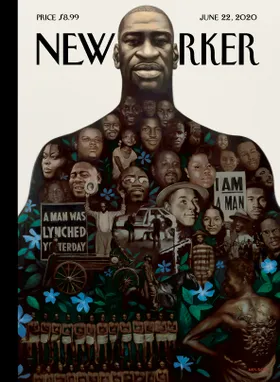
Replacing Hobbes’s Leviathan with Haraway’s Cyborg could help tackle this issue though by nulling all of these latent contracts. While Hobbes’s Leviathan is a solution to his brutish state of nature, it created a society that was racialized (white people over non-white peoples), misogynistic (men over women), and possibly even heteronormative, if such a reproductive vision of sexuality exists within it. The Cyborg, on the other hand, would work to remove the effects of these contracts on the formed society, since the Cyborg is post-gender and works to transgress boundaries (Haraway partially wrote the Cyborg as a criticism of traditional feminism for its ignorance of intersectional oppressions, such as that of women of color, in favor of superficial unity among women). In replacing an overbearing image like the Leviathan with the inclusive image of the Cyborg, we can truly work with a society that recognizes the differences between races, genders, and sexualities as a result of
the contracts imposed by the Leviathan but still works to equalize empathetically. This replacement does not even have to be in spite of the eroticism of the original Hobbesian philosophy—this is simply an act to ensure that that eroticism is not exclusionary at the same time.
This act of replacing the image of the Leviathan with the image of the Cyborg as a way of nullifying all of these latent contracts that dictate how our society operates could be attributed to what philosopher Walter Benjamin described as “divine violence” in his iconic essay “Critique of Violence.” In this essay, Benjamin characterizes two forms of violence, law-making and law-preserving, that the state employs in order to perpetuate this perception of a mythic violence over its citizens, where the state holds the ultimate power to judge, to punish, and to execute. Benjamin then outlines the form of violence that would be able to counter this mythic violence, in the spirit of Newton’s third law of motion (every force will be met with a force that is equal and opposite): divine violence. Whereas mythic violence is meant to make laws and preserve them in the name of the state, divine violence is only meant to destroy laws for the sake of destroying laws. A similar recklessness, in terms of motivations at least, can be seen in the replacement of the Leviathan with the Cyborg: there is no point other than to be law-destroying, to get rid of the racialization, the patriarchal sex-right, the homophobia, the transphobia, and all the other bigotries that have been so ingrained in our society. The Cyborg could also be interpreted as a better, more inclusive, and more correct view of social contract theory by understanding how cloudy the role of consent truly is in these contracts. Let us humor the fantasy behind the Cyborg for a moment: a person could willingly get and actively consent to cyborgian modifications in order to alleviate an ailment or handicap (e.g. an amputee getting a prosthetic), and a person could just as well begrudgingly or be forced to accept cyborgian modifications due to injuries from a sudden accident. In both, regardless of how the “consent” was obtained, the person ended up as a Cyborg. Under the Leviathan, consent is always assumed to be given equally and enthusiastically. Under the Cyborg, it is recognized that “consent” is a loose term in regards to these social contracts and that it could have been obtained through various means, including force, but, in spite of that fact, peace will be made with those aspects of society and will be considered moving forward, the same way a person will have to make peace with their cyborgian modifications and move forward to better their life with it regardless of how and why they got them in the first place.
In similar fashions of replacement, Lakitsch, in his article “Hobbes in the Anthropocene: Reconsidering the State of Nature in its Relevance for Governing,” points out how, despite his recognition of the influence of interpersonal relationships and nonhuman actors on politics,
Hobbes’s idealization of politics and society, of his Leviathan, as completely independent of all of that (the Leviathan is meant to be a safe haven from the state of nature, after all), ends up failing to adequately prepare for and explain phenomena that result in the formed commonwealths as a result of these factors, such as riots or climate change. Thus, a reimagining of the Hobbesian multitude that gives way to the Leviathan, one in which the multitude also encompasses these human and nonhuman actors, needs to be considered. However, this can be remedied by simply replacing the Leviathan with the Cyborg. The Cyborg already acknowledges the influence the nonhuman has on the human by being a
machine-organism hybrid, and the Cyborg goes further by also acknowledging the nonphysical just as much as the physical, which could help in recognizing noncorporeal threats to society (like climate change) more readily.
With international relations theory, Grewal, in his article “The Domestic Analogy Revisited: Hobbes on International Order,” talks about how an overemphasis on Hobbes’s domestic analogy resulted in a misinterpretation of his true stance on international relations: he did not see the solution to international anarchy as a separate international Leviathan but rather one brought about inherently through the production of individual stable commonwealths, since Hobbes did not see the domestic and international as completely distinct political spheres. Once again, this could be remedied through the adoption of Haraway’s Cyborg in place of the Leviathan, since the Cyborg is already meant to handle these boundaries and their transgressions: just as much as how technology makes up the Cyborg as its organic parts, the domestic can make up the international and vice versa. Geographer Derek Gregory even recognizes this connection in his essay “The Everywhere War,” where he identifies cyberspace as one of the borderlands in which significant international conflict occurs. The fact that domestic bodies create an international sphere of discourse conflict and violence in a digital landscape where the borders of what is “domestic” and “international” is inherently muddied due to being digital is an indication that a cyborgian understanding of these relationships may be more realistic to our current situation, for the nations have become cyborgian themselves.
All in all, it seems that adopting the Cyborg in place of the Leviathan seems to be a progressive and more accurate change in terms of modern society, as it looks to the future by nulling the other bigoted contracts latent within the Leviathan and accepting the muddiness between the boundaries that were more strictly enforced by the Leviathan. The Cyborg is also a better, more accurate representation of 21st century society and beyond. Right now, we live in an era where society exists just as much digitally as it does physically. This unity between the organic and technological can also be seen in the arts, a field that was thought to remain untouched by artificial intelligence and the likes for years to come, with Holly Herndon co-producing an album, PROTO, using an AI singer named Spawn and with trans musicians like SOPHIE and Lyra Pramuk using technology to modulate voices to produce music that imitate standard forms (e.g. pop and folk) but with post-gender singers. The Cyborg is more true to our reality today, and replacing the Leviathan with it seems to be more convenient in our ideological endeavors.
Listen to VYZEE by SOPHIE for an example of vocal modulation used for gender euphoria: https://youtu.be/KXdRl6Ml37I
Listen to New Moon by Lyra Pramuk for an example of vocal modulation used to go beyond gender/human biology: https://youtu.be/nEGycMxt9tM
Listen to Godmother by Holly Herndon, J-Lin, and Spawn for an example of AI-produced music: https://youtu.be/sc9OjL6Mjqo
References
Benjamin, W. (1921). Critique of Violence.
Boucher, J. (2016). “The erotic political philosophy of Thomas Hobbes.” Canadian Journal of Political Science, 49(1), 89-105.
Gregory, D. (2011). “The everywhere war.” The Geographical Journal, 177(3), 238-250.
Grewal, D.S. (2016). “The Domestic Analogy Revisited: Hobbes on international order.” The Yale Law Journal, 125(3), 618-680.
Haraway, D. (1985). “A Cyborg Manifesto: Science, technology, and socialist-feminism in the late twentieth century.” Socialist Review.
Hobbes, T. (1651). Leviathan, or the Matter, Forme, & Power of a Common-Wealth Ecclesiasticall and Civill. Oxford at the Clarendon Press.
Lakitsch, M. (2021). “Hobbes in the Anthropocene: Reconsidering the state of nature in its relevance for governing.” Alternatives: Global, Local, Political, 46(1), 3-16.
Mills, C. (1999). The Racial Contract. Cornell University Press.
Pateman, C. (1988). The Sexual Contract. Polity Press.